Module
13 Integration
In this module, you will be able to:
Participation takes place in a variety of human environments. In the previous modules, you have learned the various avenues of participation. Participation includes not only voting or running for a specific elective position in the government. It also involves engagement through the larger civil society.
This section explores the issues that confront a specific group of citizens—the youth. To what extent are you, the youth, encouraged to get involved in civic and political affairs? What concrete actions can you perform as a youth to show your contribution to our society? How are you included in the prospect of governance? Why should you also be consulted in matters of public concern? What must be done to address youth involvement in governance? These and more are presented in this module. As an integration of all the concepts and theories you have learned, this section will allow you to apply the knowledge you gained in the world beyond the comforts of the classroom. As such, this integration module shows how and when theory meets practice.
“No one is born a good citizen; no nation is born a democracy. Rather, both are processes that continue to evolve over a lifetime. Young people must be included from birth. A society that cuts itself off from its youth severs its lifeline; it is condemned to bleed to death.”
– Kofi Annan, Former UN Secretary-General
Political Engagement and the Youth
One may ask: “Who are the youth?” According the United Nations Educational, Scientific, and Cultural Organization (UNESCO) (2016), youth is “a period of transition from the dependence of childhood to adulthood’s independence and awareness of our interdependence as members of the larger community.” While the youth is a more fluid category than a fixed-age group, age is the easiest way to define the youth in terms of education and employment.
UNESCO adds that a youth is a person who is between the age where he or she may leave compulsory education, and the age where he or she finds his or her first employment. UNESCO uses varied definitions of youth because high levels of unemployment and high cost of putting up an independent household place many young people into prolonged periods of dependency from adults. Nonetheless, UNESCO uses the definition of UN, which specifies that youth are those persons between the ages of 15 and 24.
The youth can be a creative force and a dynamic source of innovation in society. They have contributed, catalyzed, and participated in political, social, and economic changes all over the world. The youth have also engaged in peace building, especially in countries characterized by conflict. The international community, through several international conventions and UN resolutions, has recognized these contributions of the youth be it local or international in nature.
Big Idea
Today’s young generation has a strong potential in achieving societal development. Through its entities, the state must provide opportunities for young people to participate in governance and public affairs.
The following are some of the various resolutions and statements that manifest the international community’s recognition on the indispensable role of the youth.
Source: Enhancing Youth Political Participation throughout the Electoral Cycle (published by the United Nations Development Program, 2013) available at http://www.undp.org/content/dam/undp/library/Democratic%20Governance/Electoral%20Systems%20and%20Processes/ENG_UN-Youth_Guide-LR.pdf
As mentioned in the previous modules, participation is a fundamental right in the political community. Through active participation and citizenship, the youth become empowered to play a vital role not only in their personal development, but also in the advancement of their community aspirations. However, several issues confront the youth such as poverty, limited access to education, various forms of discrimination, and few opportunities for employment, among others. For the youth to actively and effectively participate, they must be informed and educated about and be given access to their civil rights (United Nations 2013).
Reflect Upon
The Philippine Constitution recognizes the vital role of the youth in nation-building. As a young person yourself, what concrete actions have you done for the development of your community?
What Have I Learned So Far?
What are the programs and activities in your barangay that show youth empowerment and participation?
Youth and Participation: A Look at Some Major Issues and Cases
The UN, through the United Nations Development Programme (UNDP), lists fundamental issues relevant to governance and youth participation. Among these are the following:
Big Idea
Despite the presence of policies and legal frameworks in the country, young people still need to make substantial contributions in resolving many social issues and challenges today.
Young men and women tend to feel excluded and marginalized in their communities given the limited opportunities and exposure provided for them to participate meaningfully in decision-making processes (UNDP-Focal Point on Youth UNDESA, n.d.).
The UNDP and other UN entities have a strong reference for a rights-based approach in promoting programs for youth participation. Because participation is a basic democratic right, an effective and meaningful youth political participation should have the following democratic attributes:
1.Consultative
2.Entails youth-led participation
3.Involves youth collaborative participation
To reach the objective of substantive inclusion of the youth in governance and in decision-making, the UNDP further claims that actions must revolve around two main commitments in political inclusion.
1.Support to young people’s participation in inclusive political processes and democratic practices through the following:
a. Promotion of an enabling environment (legal frameworks, policies, and programs) for young people’s participation in a broad range of processes and areas (electoral and parliamentary processes, public administration, local governance, peace-building arenas) at local, subnational, and national levels
b. Promotion of young people’s skills and capacities to participate actively in democratic practices, including in local, national, and international contexts (leadership workshops, etc.)
c. Promotion of young women’s participation and presence in political office and decision-making at all levels (both in elective and nonelective positions)
2.Support to young people’s inclusion in decision-making and in all levels of development processes through the following:
a. Effective participation of young people and young people-led organizations in UN governance and decision-making processes
b. The ability of young people and young people-led organizations to contribute to the achievement of durable solutions for humanitarian and peace-building initiatives, focusing on enabling young women and men to become active leaders in global efforts to achieve sustainable human development as a long-term investment
Adapted from: UNDP Fact Sheet, available at http://www.un.org/esa/socdev/documents/youth/fact-sheets/youth-political-participation.pdf
Reflect Upon
Have you ever participated in a youth development driven program? Share your experiences with the class.
Beyond Walls 13.1 Read and Answer
The United Nations (UN) recognizes the importance of youth as a major human resource for development and as key agents for positive social change. UN-habitat and the Focal Point on Youth prepared a fact sheet as part of collaborative effort of the Inter-Agency Network for Youth Development. You can access the copy of the article at http://www.cpahq.org/cpahq/cpadocs/Youth%20Participation%20-%20UN%20paper.pdf. Read the short article and answer the following questions:
1.What is the importance of the full and effective participation of youth and youth organizations in policy- and decision-making processes of the government?
2.What did you learn from the article about youth involvement in governance?
Empowering the Filipino Youth: Some Programs
There are various successful efforts in civic and political activism in the Philippines initiated by the youth. As what you have learned from the previous modules, the Philippines has an environment that is conducive to the development of civil society organizations. Similarly, the Filipino youth are being encouraged to participate in civil and political activities, whether through formal (institutionalized mechanisms in the government) or informal (volunteerism) means (David 2013). Thus, the Filipino youth are called to participate in civil and political activities, apart from joining mass protests and rallies, and engagement through information and communications technology (ICT) as made available to them.
The Philippines stands out among its Asian neighbors due to the presence of a diverse set of opportunities for youth engagement. Such avenues may vary from large-scale institutionalized organizations in the government, to small faith-based ones that encourage volunteerism among high school and college students. Similarly, the government has implemented a system of representation in governance for the young people including the Sangguniang Kabataan, the National Youth Commission, and several youth sectoral councils in different commissions in the government (Hutter 2008, in David 2013).
The Legal and Institutional Environment
Youth participation in the Philippines is recognized in various legal frameworks including the 1987 Constitution. For instance, Article II, Section 12 provides that “…The natural and primary right and duty of parents in the rearing of the youth for civic efficiency and the development of moral character shall receive the support of the Government.” In the same article, Section 13 specifies that “the State recognizes the vital role of the youth in nation-building and shall promote and protect their physical, moral, spiritual, intellectual, and social well-being. It shall inculcate in the youth patriotism and nationalism, and encourage their involvement in public and civic affairs.” This is how institutions in the Philippines have recognized the potentials of the youth.
The youth’s participation through a party-list representative in the Congress is also stipulated in Article VI, Section 5, paragraph 2 of the constitution. As such, the youth is given a chance to be represented in the halls of the government as among the marginalized sectors in the country. The out-of-school youth are also recognized in the constitution, specifically in Article XIV, Section 2, paragraph 5: “the State shall provide adult citizens, the disabled, and out-of-school youth with training in civics, vocational efficiency, and other skills.”
Big Idea
Youth participation in governance is being recognized by various legal frameworks in the Philippines. Institutionalizing youth participation in governance and public affairs plays an important role in sustaining social development in the country.
Apart from these general provisions in the constitution, the Congress also ratified Republic Act No. 8044 or The Youth in Nation-building Act, which created the National Youth Commission and established a national comprehensive and coordinated program on youth development. This program is based on the following principles:
There are also several institutions or agencies that deal with the issues of the youth. The Department of Social Welfare and Development (DSWD) is the government agency tasked to look at welfare issues of the youth. There are also other support institutions such as the Youth Sectoral Council of the National Anti-Poverty Commission, the National Youth Parliament, the National Volunteer Service Coordinating Agency, and the Sangguniang Kabataan under the Office of the President.
What Have I Learned So Far?
What is the role of the youth in governance, social development, and technological innovations? As a member of today’s young generation, what specific contributions can you make in Philippine society?
Some Cases of Youth Engagement
Hutter (2008) identified a typology of youth civic engagement in her study on young people’s civic engagement in East Asia and the Pacific. The youth’s community service and volunteering come in a variety of ways:
1.Formal, long-term service – 20 hours per week of service for three months or longer
2.Part-time volunteering – anything less than formal, long-term service but more than two hours per week for two months
3.Occasional volunteering – anything less than the above
4.Service-learning – is a teaching method that enriches learning by engaging students in meaningful service to their schools and communities. Young people apply academic skills in solving real-world issues and in linking established learning objectives with community needs. This can be either school or nonschool based.
5.International volunteering – volunteers offer services to communities in countries other than their own
6.Mutual aid – providing assistance and support to others within the same community or social group; the distinction between the volunteer and the beneficiary may be less clear
7.Governance – representation to, and lobbying of, government bodies to monitor government policies, services, and programs
8.Advocacy and campaigning – raising public consciousness or working to change legislation
9.Youth media – video, radio, film, newspaper, or other forms of media production being utilized by young people; audience may be other young people or adults
10.Social entrepreneurship – creating innovative solutions to social problems by designing products or offering services
11.Leadership training and practice – mechanisms for learning and exercising leadership skills, including workshops as well as participation in volunteer activities
The youth civic participation programs in the Philippines, both at the national and the local levels, also fall within the categories in this typology. The following is a list of some of these activities (Hutter 2008, Innovations in Civic Participation, n.d.).
There are also several civil society and private sector initiatives, local or international, that aid in the project of youth civic engagement in the country. The following are some of them (Innovations in Civic Participation, n.d.):
Reflect Upon
Identify some projects or programs implemented by your Sangguniang Kabataan. In what way can you contribute to the implementation of these programs?
What Have I Learned So Far?
1.Do you think the Philippine government has provided substantial legal and policy frameworks to ensure youth political participation? Provide specific examples to support your answer.
2.If you will propose a policy that will harness youth development, what will it be and why?
Challenges and Prospects
Hutter (2008) categorized the Philippines (together with Thailand) as a country that has decentralized support for youth civic engagement, including policies, programs, and youth bodies. She also noted that youth participation in the country is integrated in the school curricula and that youth-oriented programs are run by multiple organizations, including youth-led ones.
The inclusion of the NSTP in the Philippine higher education curricula allows the youth to be educated about civic involvement. Moreover, the NSTP also instills in the youth the value of volunteerism through participation in different programs that involving community building and youth development. Such involvement in civic affairs brings forth a realization among the youth that they are proactive movers of the society.
However, challenges still confront youth engagement in the Philippines, a country categorized as a “democratizing state with strong civil society.” The following table presents this.
Table 13.1 Challenges to and Supports for Youth Civic Engagement (in the Philippines and in Thailand)
| Challenges for Engagement | Supports for Engagement |
|
• Decreasing government funding for youth civic engagement activities (Philippines)
• Inefficiency and corruption of National Youth Council (Philippines)
• Weak economy (Philippines)
• Weak education system (Philippines)
• High levels of youth unemployment and migration (Philippines)
• Gender inequalities
• Difficulty for young people to balance studies, responsibilities at home, and participation in youth civic engagement activities
• High financial cost of participating in activities
• Distance of activities from home
• In some cases, lack of parental support for participation
• Lack of information about programming options
• Negative or mixed media portrayals of young people
|
• Government decentralization allowing greater youth participation at the local level
• Significant government support for youth civic engagement
• Support for youth civic engagement within the formal education system
• Adult role models and collaborative youth-adult relationships
• Religious support for youth civic engagement
• [Value of helping others] in local culture
• University support for youth civic engagement
|
Adapted from: Hutter (2008)
It is also important to take note that there are other venues for youth political engagement, and some of these may be considered extreme or extra-legal, if not at all violent. For instance, the UN Security Council (2013) reported that children aged 10 to 17 years old are recruited and used by the MILF, Bangsamoro Islamic Freedom Fighters, NPA, and the Abu Sayyaf Group in armed conflicts. The participation of children ranges from support roles (as messengers or transporters of ammunitions) to combat roles. The report also mentions the Armed Forces of the Philippines’ use of children as guides and informants in military operations against the NPA. Putting an end to this practice remains to be one of the challenges in integrating the youth in the country’s legal, political, and social institutions.
On the other hand, student activism or street parliamentarism is a widely practiced form of participation among the youth, particularly the students. In this form of participation, the youth engage with the state and attempt to influence policy making, pressure the government for reforms, and promote youth interests at large. Previously criticized as apathetic, the Filipino youth have recently proven that they are relevant in ushering societal change, and this they have done through voting. In the May 2016 elections, the candidates intensely persuaded for the youth’s vote—a proof that this sector is potent in decision- and policy-making. The said elections had 82% voter turnout, with the youth (consistent with the UN’s definition of any person aged between 15 and 24) comprising 20.24% of the registered voters (COMELEC 2016).
Today, the Filipino youth are considered to be highly technologically literate. Their use of social media has transformed their avenues of engagement into the online platform. The Philippine Daily Inquirer (PDI) (2016) observed that “social media is a powerful catalyst for the engagement of the collective, but particularly—and critically—the young”, especially during the 2016 elections. Online platforms allowed the youth to express their political views through the Web. Similarly, online campaigns had the youth as targets by the candidates. While there is a criticism to raise the level of discourse in social media sites (Facebook, Twitter, or other platforms), the youth are, nonetheless, no longer merely occupied with leisurely affairs and hardly of political concerns (PDI 2016).
Looking at some global trends may also suggest important challenges or prospects in the status of the Filipino youth’s participation in governance, either as political candidates or as voters. In a survey done by the Inter-Parliamentary Union (IPU), the Philippines ranked 56 out of 126 countries in terms of the number of legislators whose ages are 30 years and below and are members of the lower house of the national assembly. The country ranks fairly compared to our Southeast Asian neighbors (except for Indonesia at rank 33 or 2.9%), but falls way behind European states such as Sweden, the world leader. At the upper house (the Senate), the Philippines ranked at the bottom (of 43 countries) as no senator aged below 30 years was elected in office. Such ranking is apparent because the constitution requires that an elected senator must be at least 35 years old. Nonetheless, several countries have recently reduced the age for candidacy requirement such as in Algeria (from 28 to 25 years old), Kenya, Morocco, and the United Kingdom (18 years old) to increase youth representation as political reform (IPU 2016). What do you think does the constitutional requirement in the Philippines say about youth participation in the Senate?
The tables below summarize the survey by the IPU.
Table 13.2 Global Ranking of Legislators Aged under 30 (in Percent) in the Lower House
| Rank | Percent | Country(ies) |
| 1 | 12.3 | Sweden |
| 2 | 10.9 | Ecuador |
| 3 | 10.5 | Finland |
| 4 | 10.1 | Norway |
| 5 | 7.1 | Andorra |
| 6 | 6.6 | Italy |
| 7 | 6.5 | the former Yugoslav Republic of Macedonia, Tunisia |
| 9 | 6.1 | Denmark, Ethiopia |
| 11 | 5.9 | Cuba, Suriname |
| 13 | 5.8 | Chile |
| 14 | 5.6 | Bhutan, Slovenia |
| 16 | 5.2 | Somalia |
| 17 | 5.0 | Latvia |
| 18 | 4.8 | Serbia |
| 19 | 4.7 | Canada |
| 20 | 4.6 | Austria |
| 21 | 4.2 | Kyrgyzstan |
| 22 | 3.9 | Brazil |
| 23 | 3.5 | Costa Rica |
| 24 | 3.4 | Gambia, Guatemala |
| 26 | 3.3 | Bulgaria, Luxembourg, San Marino |
| 29 | 3.2 | Iceland |
| 30 | 3.1 | United Kingdom |
| 31 | 3.0 | Uruguay, Zimbabwe |
| 33 | 2.9 | Indonesia, Malta |
| 35 | 2.8 | South Africa |
| 36 | 2.7 | Georgia, Netherlands |
| 38 | 2.5 | Germany, Paraguay, United Arab Emirates |
| 41 | 2.4 | Bosnia and Herzegovina, Sri Lanka, Trinidad and Tobago, Venezuela (Bolivarian Republic of) |
| 45 | 2.3 | Argentina |
| 46 | 2.2 | India, Portugal |
| 48 | 2.1 | Albania |
| 49 | 2.0 | Belgium, Czech Republic, Estonia, Hungary, Poland , Sudan |
| 55 | 1.8 | Niger |
| 56 | 1.7 | Israel, New Zealand, Philippines |
| 59 | 1.6 | Afghanistan, Morocco |
| 61 | 1.5 | Switzerland |
| 62 | 1.3 | Montenegro, Russian Federation, Rwanda |
| 65 | 1.2 | China, Ireland, Vietnam |
| 68 | 1.1 | Algeria, Nicaragua, Uganda |
| 71 | 1.0 | Equatorial Guinea, Greece |
| 73 | 0.9 | Burundi, Spain |
| 75 | 0.8 | Armenia, Japan |
| 77 | 0.7 | Croatia, Lithuania, Romania, Slovakia |
| 81 | 0.6 | United Republic of Tanzania, Zambia |
| 83 | 0.5 | Myanmar |
| 84 | 0.4 | Australia, Syrian Arab Republic |
| 86 | 0.3 | Bangladesh |
| 87 | 0.2 | France |
| 88 | 0.0 | Azerbaijan, Bahrain, Belarus, Cabo Verde, Cambodia, Cameroon, Chad, Côte d’Ivoire, Cyprus, Democratic Republic of the Congo, Dominican Republic, Gabon, Ghana, Haiti, Iran, Iraq, Kazakhstan, Kuwait, Lebanon, Malaysia, Micronesia (Federated States of), Monaco, Mongolia, Mozambique, Namibia, Nigeria, Oman, Peru, Qatar, Republic of Korea, Sao Tomé and Principe, Senegal, Seychelles, Singapore, Solomon Islands, Timor-Leste, Thailand, Tuvalu, United States of America |
Note: Data were not provided on the age distribution of members of parliament in Mauritius.
Table 13.3 Global Ranking of Legislators Aged under 30 (in Percent) in the Upper House
| Rank | Percent | Country(ies) |
| 1 | 9.1 | Bhutan |
| 2 | 5.9 | Kenya |
| 3 | 3.2 | Trinidad and Tobago |
| 4 | 2.7 | Netherlands |
| 5 | 1.7 | Belgium, Ireland |
| 7 | 1.1 | Spain |
| 8 | 0.5 | Myanmar |
| 9 | 0.0 | Afghanistan, Algeria, Argentina, Australia, Austria, Belarus, Bosnia and Herzegovina, Brazil, Burundi, Cambodia, Canada, Chile, Czech Republic, Dominican Republic, France, Gabon, Germany, Haiti, India, Japan, Kazakhstan, Malaysia, Namibia, Nigeria, Paraguay, Philippines, Poland, Romania, Russian Federation, Rwanda, Switzerland, United Kingdom, United States of America, Uruguay, Zimbabwe |
Note: Calculations for Zimbabwe are based on responses from 38 of 80 members of parliament.
Source: Inter-Parliamentary Union (2016), available at http://www.ipu.org/pdf/publications/youthrep-e.pdf
The World Values Survey (Wave 6: 2010–2014) (table 13.4) also presents some trends in youth political participation in the Philippines including voting; membership in political parties; joining acts of protest, demonstrations, and boycotts; and signing petitions, in comparison to world and Southeast Asia. Of the indicators of political participation in the Philippines, voting is the highest at 62.0%, way above the world average of 43.6%. This definitely is a positive aspect of youth participation in the country and this affirms the youth’s participation in elections as noted in the previous discussions. The use of other means, such as joining boycotts and active membership in political parties, is the lowest at 3.5% and 5.8%, respectively. Similarly, other aspects of participative democracy such as signing of petitions (6.8%) and participation in demonstrations (10.7%) are yet to be fully utilized by the Filipino youth. Hence, the youth can be sources of social changes and innovations.
Table 13.4 Political Participation in the Philippines in a Comparative Perspective*
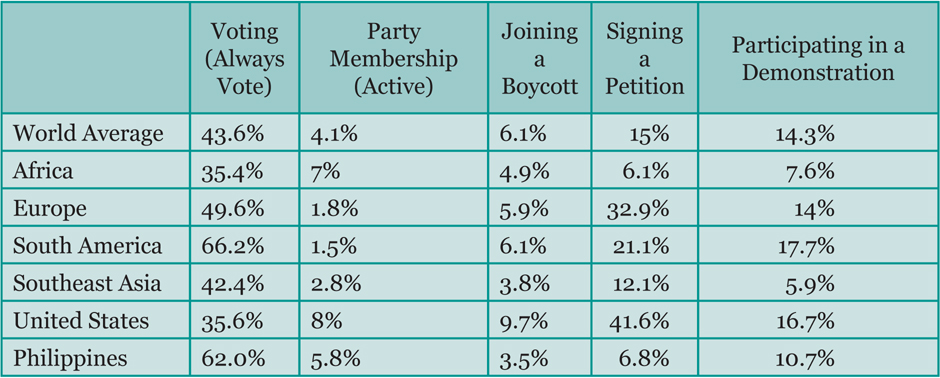
* Age group: 18–29 years old
Source: World Values Survey (Wave 6, 2010–2014), available at http://www.worldvaluessurvey.org/WVSOnline.jsp
Beyond Walls 13.2 Apply It in Real Life
You are youth advocate and communications expert who is tasked by the Sangguniang Kabataan National Federation Council to evaluate an existing program about youth empowerment. You need to make a three-part commercial video that can be posted on any online platform (e.g., video-sharing site, social media, blog). Each part should not be longer than one minute. The video should contain different opportunities that the youth can explore to participate in the development of his or her barangay. Your output will be evaluated based on creativity, ability to attract the attention of the youth, content and expected information, and modes of presentation.
Some Reminders:
1.The first video should contain information about the significance of youth participation in the government.
2.The second video should contain different opportunities for youth participation on various programs, projects, and activities.
3.The third video must present a message on how youth participation can create a difference at the community level.
Beyond Walls 13.3 Apply It in Real Life
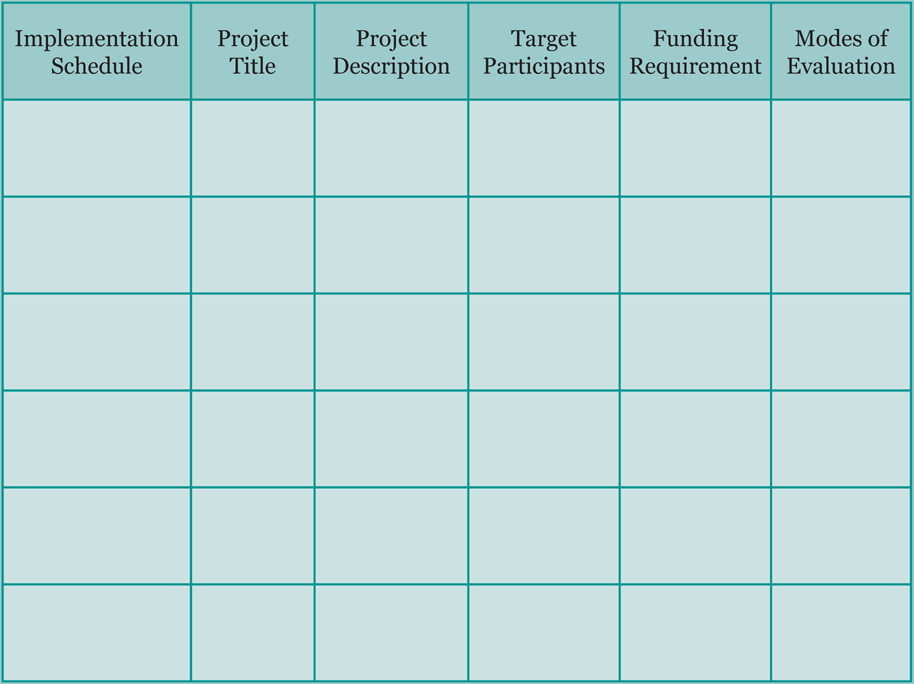
You are recently elected as the Sangguniang Kabataan chairperson in your barangay. The first task assigned to you and your council by the Department of Interior and Local Government (DILG) is the creation of a youth development plan. To do this, you should conduct a research in your barangay about youth empowerment. Then translate your findings into a development plan. This plan will be a document that enumerates and describes the programs and plan of actions that you will implement during your administration. Your development plan will be evaluated by the secretary of the DILG based on the innovative programs identified, ability to implement programs, creativity and attractiveness to youth participation, quality of presentation, and compliance to the template provided here.
Output: Project proposal/plan for youth empowerment and political engagement
Template for the development plan:
Extend Your Knowledge
You may check the following online resources to further your understanding of youth civic engagement.
Essential Learning
The youth has an undeniable role in nation-building, governance, and development. This is recognized not only in the Philippines, but also by other states throughout the world. The very fact that the youth’s role has received recognition internationally indicates that they are a potent force in ushering social change in a massive and significant scale. In the Philippines, the constitutional and legal environments serve as the structural backbones through which the political and civil engagements of the youth are materialized. While it is true that several challenges remain, there is no doubt that the continued efforts of the government, civil society, business and private sectors, people, and youth themselves indicate a brighter future for youth engagement and empowerment. The extent to which the state concretizes its policies toward youth empowerment will test the type of democracy it intends to cultivate for the future generations. The Philippines is being challenged by this global initiative.