Module
11 Civil Society and Social Movements
In this module, you will be able to:
If political parties in the Philippines have failed to realize their primary goal of articulating and aggregating interests given the problems presented in the previous module, it is material to ask—have civil society and social movements taken the place of political parties in the prospect of development and governance? You have learned in the previous module that political parties serve as links between individuals and the government. Are civil society organizations and interest groups and movements now in the process of replacing political parties as crucial links between the government and society?
As part of the discussion on political interaction, this section presents yet another manifestation of state-society interaction, that is, the relationship between civil society and social movements, and the Philippine state. This section thus highlights another aspect of group politics, but its focus is on actors outside the sphere of a political entity. This part assesses the roles taken by the civil society in Philippine governance and development.
Defining Civil Society
The United Nations refers to civil society as the “third sector” of the society, along with government and business. The civil society is considered a social sphere independent from both the state and the market. It comprises civil society organizations and nongovernmental organizations.
The term civil society organizations (CSOs) refers to those non-state, nonprofit, voluntary organizations in this social sphere. Thus, CSOs include a wide array of organizations, networks, associations, groups, and movements that often come together to push for the advancement of their common interests by means of collective action (WHO 2015).
Big Idea
When individuals come together to pursue a common interest given a particular issue, a civil society group is formed. Also known as a nongovernmental organization (NGO), the civil society group serves as the third actor in governing today’s society.
Nongovernmental organizations, on the other hand, are nonprofit and voluntary citizens groups, which are organized on a local, national, or international level. They perform service and humanitarian roles, bring citizen concerns to governments, advocate and monitor policies, and encourage participation through information dissemination. Similarly, they provide analysis and expertise on specific issues on the environment, health, and human rights (NGO Global Network 2016).
The following are considered fundamental characteristics of successful civil societies (Ghaus-Pasha 2004):
The civil society can have a positive influence on both the state and the market. The civil society has become increasingly important in the promotion of good governance, effectiveness, and accountability. Ghaus-Pasha (2004) highlights the ways by which the civil society can further good governance.
Role of Civil Society in Good Governance
Reflect Upon
If you will join a civil society group, what are the factors and conditions you will consider? How will your participation in an NGO build your citizenship?
CSOs take a variety of forms. Nonetheless, the AUGUR project, a research project co-funded by the European Commission, lists five main types of CSOs and two hybrid organizations (civil organizations but are not completely separated from states or business firms, such as business CSOs and government-oriented CSOs). While not all inclusive, the list presents a good categorization of CSOs.
Table 11.1 Types of CSOs
| Types of CSOs | Characteristics |
| Religious | These CSOs do not necessarily promote worship of a religion, but they are more or less linked to a given religion and they act following a religious precept. Their fields of intervention include education, health, emergency relief, and basic needs assistance (e.g., Red Cross). |
| Community-based | These are, most of the time, local CSOs based on solidarity, resource sharing, and community building. They are primarily focused on development (e.g., Grameen Bank), housing (e.g., the Urban Land Reform Task Force in the Philippines), social services, civil and legal assistance, and culture and recreation. |
| Philanthropic | These are organizations that serve a cause without any religious affiliation. They are based on values such as generosity and humanism. They include private and business foundations and independent NGOs (e.g., Bill & Melinda Gates Foundation). |
| Expert | They act in new fields that require some scientific knowledge (e.g., environment, finance). They are not exclusively composed of experts and scientists but they claim to have an expertise unit and they publish some technical reports (e.g., Greenpeace International). |
| Trade Unions | These are labor and worker associations which promote workers’ interests. The Philippines is also home to trade unions. The Trade Union Congress of the Philippines is the biggest confederation of labor federations in the country, with almost 30 federations representative of sectors and industries from agriculture to manufacturing to services (www.tucp.org.ph). |
| Business | These include business and industry NGOs (BINGOs) which defend a given firm’s or industry’s interests. These developed in Anglo-Saxon countries, particularly the United States. They are different from business lobby/interest groups, which generally promote employer or corporate interests. Larger corporations often have lobbyists who will monitor and promote various laws and programs for the specific interests of the corporation. Companies and organizations also come together in larger groups to work for general business interests (Boundless Political Science 2016). There are also business lobby groups in the Philippines such as those in the sugar and tobacco industries. |
| Government-oriented | Government-oriented NGOs (GONGOs) are independent civil organizations, which are more or less influenced and controlled by national authorities. These developed in industrialized Asian countries, particularly in China. |
Source: AUGUR European Commission-European Research Area, Seventh Framework Programme, available at http://www.augurproject.eu/IMG/pdf/cso_note_provisional_draft5_june_2012.pdf
Civil society organizations also employ a number of strategies in the pursuit of their interests and goals in governance. To influence national policy formulation, CSOs use education, persuasion, collaboration, litigation, and confrontation (Covey 1994 in Ghaus-Pasha 2004). The following table summarizes the tactics and skills required in the realization of these strategies.
Table 11.2 Some of CSO’s Strategies and Tactics
| Strategies | Tactics | Skills |
| Education | Meetings, media, workshops, conferences, commissions | Research, information, analysis, dissemination, communication, and articulation |
| Collaboration | Building relationships, links, and cooperation with government and other CSOs | Communication, organization, mobilization, networking technical capability, transparency, openness, and effectiveness |
| Persuasion | Meetings, workshops, coalition, lobbying, media, demonstration | Organizing, communication, motivation, negotiation, commitment, and vision |
| Litigation | Use of courts | Legislation and communication |
| Confrontation | Demonstration, public gatherings, speeches | Mobilizing, communication, motivation, and leadership |
Source: Ghaus-Pasha (2004), available at http://unpan1.un.org/intradoc/groups/public/documents/un/unpan019594.pdf
Reflect Upon
1. Civil society groups are considered “watchdogs” to the government and business entities. What do you think about this label? How do NGOs foster good governance?
2.Are you planning to join a civil society group? What advocacy will you push through in your chosen voluntary organization?
What Are Social Movements?
A social movement is a collective body that has a high level of commitment and political activism, and is not necessarily based on formal organization (Heywood 2013). It differs from civil society groups because social movements are attempts to change society through collective action. They transpire when large groups of individuals or organizations work for or against change in specific political or social contexts. They are non-institutionalized, because just like CSOs, they occur outside of governmental institutions. On the other hand, new social movements (sometimes referred to as “new politics”) are those that attract the young, better-educated, and relatively affluent individuals, including the post-material orientation and commitment of these individuals to new forms of political activism (Heywood 2013). A distinction must also be made between social movements and social movement organizations (SMOs). An SMO is an organization that is or has been associated with a social movement, and which carries out the tasks necessary for any social movement to survive and be successful (Christiansen, n.d).
Big Idea
Social movements are reflections of a vibrant democracy. They provide opportunities for people’s voluntary participation in public and political affairs of society.
Aberle (1966) describes four types of social movements based on two important questions: (1) Who is the movement attempting to change? (2) How much change is being advocated? The figure below summarizes how a social movement may either be alternative, redemptive, reformative, or revolutionary based on these questions.

Fig. 11.1 Types of social movements according to Aberle (1966)
Social movements follow a process by which they emerge, coalesce, and bureaucratize. Such process leads to either the success or failure of the social movement. The stages of social movements are presented in the figure below.
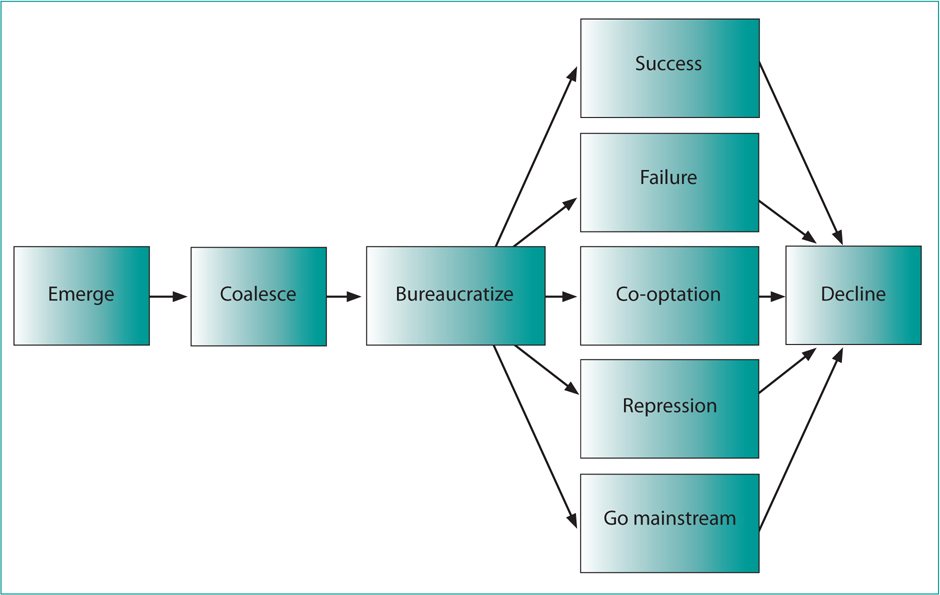
Fig. 11.2 Stages of social movements Adapted from: Blummer (1969), Mauss (1975), and Tilly (1978)
What Have I Learned So Far?
1.What is the significance of social movements in the democracy of the Philippines?
2.To what extent can social movements influence the decisions made by the government? Provide specific groups or examples to support your answer.
Civil Society in the Philippines
According to the Asian Development Bank (2007), civil society organizations in the Philippines are seen as among the most vibrant and advanced in the world. The country has the largest number of NGOs per capita in Asia, and several key international NGOs and networks are based in the Philippines and are headed by Filipinos.
There are several types of CSOs that exist in the country, but three types are considered more important ones. The first are people’s organizations, which represent marginalized groups and are often organized based on sector, issue, or geographical area. The second are development NGOs, which are intermediate agencies that operate with a full-time personnel and provide a wide array of services to primary organizations, communities, and individuals in conjunction with the failures of the government. Finally, cooperatives are an association of persons who voluntarily joined to make equitable contributions to the capital required, patronize their products and services, and accept fair share in risks and benefits of the project (ADB 2007). CSOs in the Philippines are involved in a broad range of activities, including:
1.Education, training, and human resource development
2.Community development
3.Enterprise development and employment generation
4.Health and nutrition
5.Law, advocacy, and politics
6.Sustainable development
The legal framework for civil society in the Philippines is guaranteed in the 1987 Philippine Constitution, including, but not limited to:
Article II, Section 23: “The State shall encourage non-governmental, community-based, or sector organizations that promote the welfare of the nation.”
Article XIII, Section 15: “The State shall respect the role of independent people’s organizations to enable the people to pursue and protect, within the democratic framework, their legitimate and collective interests and aspirations through peaceful and lawful means. […]”
Article XIII, Section 16: “The right of the people and their organizations to effective and reasonable participation at all levels of social, political and economic decision-making shall not be abridged. The State shall, by law, facilitate the establishment of adequate consultation mechanisms.”
Big Idea
The existence of civil society groups, NGOs, advocacy groups, and social movements are guaranteed in our institutional and legal frameworks.
Apart from the constitution, the 1991 Local Government Code also provides for the importance of CSOs in local development. The code specifies the participation of CSOs in local government planning, policy making, and delivery of social services. Specifically, the code allows CSOs to participate and/or be represented in various local development councils fora and opportunities. There are various umbrella groups of CSOs in the country, but the more established networks include the following.
Big Idea
The growing number of civil society groups is a reflection of a vibrant democracy in the Philippines and in Asia.
Table 11.3 Some CSOs in the Philippines
| CSOs | Year Founded | Focus |
| Association of Foundations (AF) | 1972 | It advocates education, culture, science and technology, governance, social development, environment, and sustainable development. |
| Affiliated Network for Social Accountability in East Asia and the Pacific (ANSA-EAP) | 2008 | It promotes the practice of social accountability that capitalizes on existing in-country networks working in governance reform. |
| Asian NGO Coalition for Agrarian Reform and Rural Development (ANGOC) | 1979 | It is focused on food security, agrarian reform, sustainable agriculture, participatory governance, and rural development. |
| Bagong Alyansang Makabayan (Bayan) | 1985 | It fights for national and social liberation against imperialism, feudalism, and bureaucrat capitalism. Bayan advocates for the nationalistic and democratic needs of the people through legal and militant forms of struggle. |
| Caucus of Development NGO Networks (CODE-NGO) | 1991 | It represents more than 1 600 development NGOs, people’s organizations, and cooperatives nationwide. |
| National Confederation of Cooperatives (NATCCO) | 1977 | It is composed of around 1.6 million individual members coming from several cooperative federations and around 406 rural- and urban-based cooperatives. |
| National Council of Social Development (NCSD) | 1949 | It was the first NGO network given license and accreditation by the government for community-based programs for children and families. |
| National Secretariat of Social Action-Justice and Peace (NASSA) | 1966 | Created by the Catholic Bishops’ Conference of the Philippines (CBCP), it focuses on poverty alleviation, democratic governance, ecology and integrity of creation, peace, and development. |
| NGO Forum on ADB | 1991 | Its goal is to make the ADB responsible and accountable for the impacts of its own projects and policies. |
| Philippine NGO Council on Population, Health and Welfare (PNGOC) | 1987 | It promotes reproductive health, gender equity and equality, women’s rights and development, nonformal education, sustainable development, and HIV/AIDS prevention and care. |
| Philippine Partnership for the Development of Human Resources in Rural Areas (PHILDHRRA) | 1983 | It is involved in community organization and the provision of health, education, and livelihood services to marginalized groups in the countryside. |
Source: ADB Civil Society Briefs: Philippines (2007), available at https://www.adb.org/sites/default/files/publication/30174/csb-phi.pdf
Beyond Walls 11.1 Read and Answer
Despite the growing number of civil society groups in the Philippines, there are still number of criticisms against them. Read the article written by J. Putzel (2001) titled “A Muddled Democracy—“People Power” Philippine Style” at http://www.lse.ac.uk/internationalDevelopment/pdf/WP/WP14.pdf. Then answer the following questions:
1.What is the impact of civil society organizations on Philippine democracy?
2.What make NGOs in the Philippines different from those of other countries?
3.Are civil society groups able to overpower some government programs and activities? Provide specific examples.
Beyond Walls 11.2 Go Online
For more resources and activities on the roles of civil society organizations in policy making, visit the Diwa Learning Town website at http://bit.ly/diwa-PPG2ED. Submit your output to your teacher.
Social Movements in the Philippines
Colas (2002, as cited in Tadem 2006) defined social movements as a “sustained and purposeful collective mobilized by an identifiable, self-organized group in confrontation with specific power structures and in the pursuit of socioeconomic and political change.” The emergence of social movements during the colonial, the Martial Law, and the post-1986 periods—with emphasis on their goals, strategies, and factors either facilitated or hindered the achievement of their objectives within the context of democratization and development.
The social movements in the country best reflect the characteristics of Philippine politics and the Filipinos’ struggle for democratization and development (Tadem 2006). These social movements can be traced as far back as the colonial period.
Big Idea
Social movements have played an important role in some major events in the Philippines. Revolutions during colonial periods in the country have been fueled by these social movements.
From Spanish Period to the 1896 Philippine Revolution
The Spanish occupation of the Philippines saw the aggravation of the socioeconomic inequalities that existed between the landed and the landless during the pre-Spanish Philippine society. Peasant agitation emerged because of the arrangements and policies of the Spaniards, which benefited a few native landed aristocracies, the Roman Catholic Church, and the Spanish nobility (Tadem 2006). The situation produced early revolts in the 16th and 17th centuries. Several more revolts would reemerge throughout history.
Halfway the Spanish colonial era, during the 18th century, came a new type of resistance. The struggle during this period was in the form of priest-led revolts and millenarian movements, which addressed the people’s problems including tribute exaction, forced labor, and friar and military abuses. Unlike the previous revolts, the resistance during the 18th century framed its issues within the context of the Catholic faith. It must be noted, however, that issues during this period were not purely religious.
There was also political resistance that emerged through the principalia class. Unlike the priest-led revolts and the millenarian movements, the principalia demanded for greater social recognition. While they were Filipino in racial origins, they were intensely colonial in thinking. Their ascendant status and the racism of Spanish feudal ideology led them to demand for greater social recognition, which also meant more political power (Tadem 2006). Unlike the previous movements, the principalia had economic and political resources that enabled them to carry out an organized resistance against the Spaniards.
Aside from these, there also was resistance through the Propaganda Movement. The ilustrados—which include the entrepreneurial class and the landed elites—framed their issues within the context of a nation and the creation of a Filipino identity in their quest to advance their interests. The ilustrados articulated their demands (e.g., Philippine representation in the Spanish Cortes, democratic political system) through the Propaganda Movement. Their writings later guided and inspired the Katipunan to raise arms against the Spaniards. An underground movement, the Katipunan was revolutionary, mass-based, and armed unlike the Propaganda Movement. The culmination of the 19th century movements became what was known as the 1896 Philippine Revolution, which signaled the end of Spanish colonial rule in the Philippines (Tadem 2006).
Big Idea
The existence of social classes in the country has triggered several movements to achieve the goal of life improvement and development.
The American Occupation
The American rule worsened the socioeconomic inequalities in the Philippines as observed in some economic sources and outcomes. The United States was not able to institute an effective land reform program that could have addressed the wide disparity between the rich and the poor. Because of the failure to address popular economic grievance, especially those of the masses, there transpired popular resistances to the American rule that were similar to those which took place during the Spanish period.
Popular movements during this time were framed in the context of socialism. It was epitomized after the emergence of Pedro Abad Santos’s Socialist Party in 1929. His party attracted tenant farmers, farmer laborers, and urban workers. The discrediting of the poor and the blatant support to the elites led to the emergence of several organizations with socialist/communist intent. Some of these were:
The Japanese Occupation and Post-independence Period
The strength of the socialist/communist movements led to the establishment of the Hukbalahap (Hukbo ng Bayan Laban sa Hapon) in March 1942. It was established by left wing labor and peasant leaders and intellectuals. The Hukbalahap and the Partido Komunista ng Pilipinas worked closely together. The Hukbalahap had been attempting to address social issues confronting Philippines society even before Japanese occupation (Tadem 2006).
The failure to address socioeconomic issues continued to breed inequality and injustice during the postcolonial period. This resulted in the upsurge of nationalist movements in the 1960s, which extended even during the period of Martial Law.
What Have I Learned So Far?
1.What issues and challenges during the colonial period influence social movements in the Philippines at present?
2.Do you think the government has not addressed social development issues? Cite specific instances to support your answer.
The Martial Law Period
President Ferdinand Marcos would later on use the continuing upheavals and resistance movements as a basis for the declaration of martial law, which particularly put a temporary halt to student and other forms of activism.
Military and political measures were used to crush movements similar to those used in the previous eras. The national democratic movement, the mass movement of the Communist Party of the Philippines (CPP), and anti-Marcos politicians were hardest hit by these measures (Tadem 2006). The only manifestation of strong resistance came from the broad anti-regime alliance of Muslim groups known as the Moro National Liberation Front (MNLF) founded in 1974. The group’s issues on ethnicity and religion served as bases for their mobilization.
The inability of the Marcos regime to deliver its promises of social welfare—aside from the military repression and restriction of political and civil rights—furthered the democratic struggle. Such circumstances led not only to the consolidation of social movements, but also to the growth of their mass base. For instance, the CPP and its armed group, the New People’s Army (NPA) propagated further the armed struggle. Among those groups that were created or that emerged, aside from those that expanded, were the following:
■ Justice for Aquino, Justice for All, which used mass actions and peaceful protests
■ United Democratic Opposition, a moderate opposition
■ Nationalist Alliance for Justice, Freedom and Democracy, a radical opposition
■ Kongreso ng Mamamayang Pilipino (KOMPIL or Congress of the Filipino People)
■ Women for the Ouster of Marcos and Boycott (WOMB)
■ General Assembly Binding Women for Reforms, Integrity, Equality, Leadership, and Action (GABRIELA)
What Have I Learned So Far?
Why did social movements emerge as antagonists during the Martial Law period? Why are these organized movements still present today?
Reflect Upon
1. What are the factors that led social movements to be labeled as leftist groups?
2.Would you like to join a social movement against a dictatorship? Why or why not?
Post-1986 Period
Issues of poverty, underdevelopment, social injustice, and socioeconomic inequalities justified the persistence of social movements in the Philippines after the end of Marcos’ dictatorship. This time, the issues were framed in the context of democratization and return to constitutionalism.
This period saw the rise of the independent left (leftist forces that were not part of the CPP–NPA–NDF). These include social democrats, democratic socialists, environmentalists, left-leaning nationalists, and religious activists. The independent left was composed of the middle class and some labor leaders (Tadem and Tigno 2006).
For the first time since 1946, this period also witnessed the participation of the left in electoral politics. Among those that joined in the electoral contest was the Alliance for New Politics (an umbrella organization for the Partido ng Bayan, which was created by the Bagong Alyansang Makabayan or Bayan) and was joined by the Volunteers for Popular Democracy (a group of popular democrats). Thus, electoral politics was seen as an avenue for the participation, if not intervention, of social movements that influence governmental policy making.
The social movements that emerged after Martial Law advocated reform, and some of them would later on become part of mainstream politics. Nonetheless, these movements targeted as beneficiaries the vulnerable and marginalized groups in the Philippine society, including, but not limited to, women, peasants, and workers (Tadem and Tigno 2006).
Beyond Walls 11.3 Read and Answer
Read the following excerpt from an article that explores the role of civil society in policy making. Then answer the questions that follow.
Theoretical Framework
This study is anchored on political opportunity structures. These opportunities are exogenous factors, which border or empower combined actors, in this case, the social movements (Meyer, 2004). Political opportunity structures explain how the political context affects the social movements’ development and influence in a number of respects. They refer to the nature of resources and constraints outside of the challenging group (see Tilly 1978; McAdams 1982; Kitschelt 1986; Tarrow 1998). These factors either enhance or inhibit visions for mobilization, advancement of claims and exercise of strategies to influence and affect politics and policy (Gamson, 1996; Meyer, 1996). According to Kitschelt (1986) political opportunity structures function as “filters” between how the movement mobilizes and how it chooses strategies to effect change in the sociopolitical environment. The structure of political opportunity has two underlying premises: (1) Resource mobilization and (2) political state opportunities. Resources are assets considered to be the key ingredient of a successful movement and they are at the core of the birth, development and success of social movements. Resources may take a variety of forms including but not limited to knowledge, money, media, labor, solidarity, legitimacy, and internal support from powerful elite. On the other hand, resource mobilization stresses that social movements are formed when people who share grievances are able to mobilize these resources and take action from there. Some vital components for movement formation are: organizational strength, similar to the main argument of the resource mobilization theory, emphasizing that the social movement must have strong and efficient leadership and sufficient resources (Kurzman, 1996). Political state opportunities on the other hand question how the state accommodates this particular movement. It asks questions like “Does the state open on the forces of social movements? Or does the state accommodate the interests of the movements? It thus refers to the vulnerability of governmental institutions in the locus of the social movements.
In relation to this, Tarrow (1994) identified contingent circumstances in which political opportunities may arise: (1) the opening up of access to the polity to new challengers; (2) elite realignments; (3) elite divisions; and (4) changes in the capacity and propensity to use repression against challengers. Moreover, Tarrow and Tilly (2009) provided six properties of political regimes that shape this political opportunity structure: (1) multiplicity of independent centers of power within the regime; (2) relative closure or openness to new actors; (3) instability or stability of current political alignments; (4) availability of influential allies or supporters; (5) extent to which the regime represses and facilitates collective claim making; and (6) decisive changes in these properties.
This paper uses these structures of political opportunity. First, it basically identifies the resources mobilized by the National Alliance of Indigenous People Movement or Kalipunan ng mga Katutubong Mamamayan ng Pilipinas (KAMP) on their anti-mining campaign in Nueva Vizcaya (a province in Northern Philippines) and determines how the movement mobilized these. Second, it presents the political state opportunities specifically on how open the state is on the claims and agenda of the said movement. Given these, the paper explores on the relationship between the state and the movement in the context of mining. We assume then that the strength of the National Alliance of Indigenous people’s organization of the Philippines is a function of (a) internal factor – the resource mobilization of the movement, using the protests and rallies, network of indigenous peoples’ movements, and strength of organizational structure as their resources for their goal on Nueva Vizcaya anti-mining campaign, and (b) external factor – the openness of the state in accommodating the interests of the movements. As such, whether they are successful in mobilizing their claims is contingent on the dynamic interaction of the mobilizing structures that the social movements have at their disposal and the political opportunity structure in which they are embedded.
Results and Analysis
The state is significant to the resources mobilized and outcomes of communal action of a social movement. According to Rootes (1999), the crucial dimensions of these political opportunity structures are the openness or closeness of states to inputs from non-established actors. These measure the strength or weakness of capacities to deliver the effective implementation of policies once they are decided. In this paper, the National Commission on Indigenous Peoples and the agency focusing on mining issues, the Department of Environment and Natural Resources (DENR) Mines and Geosciences Bureau, represent the state. How the state accommodated these resources and actions of the KAMP against large-scale mining industry in Nueva Vizcaya is discussed in this section. It was found that the concerns of the indigenous peoples existed against the backdrop of a centralist Philippine state pushing the movement at the periphery.
THE INDIGENOUS PEOPLES’ CONCERNS IN A CENTRALIST STATE
It is evident that the DENR and NCIP work hand in hand for the mining cases faced by the tribal minorities given their joint provisions and programs. However, in the pursuit of the interests of the indigenous communities, these agencies have conflicting perspectives of the nature of the problem and the laws created to solve them. This is also exacerbated by the lack of organizational support to address the concerns of the indigenous communities.
As an official noted:
“The IPRA was promulgated in late 1997. The Mining Act of 1995 was there in 1995. These two laws have opposing principles.” “We, the NCIP, are only composed of 1058 staff all over the country.”
“The problem is this. When we approved and assured mining corporations to operate – that have complied through process, here comes the protests. This implies that our process is not effective, and then we fail.”
Notably, in the four years stay of President Benigno C. Aquino III, he did not tackle any single matter about the indigenous peoples in his State of the Nation Address–an unimpressive record. The president however announced the operation of some big mining projects that surprised the indigenous population. During the time of Ferdinand Marcos, the Commission on National Integration (CNI) followed by Presidential Assistance on National Minority (PANAMIN) was created to attend to the concerns of indigenous communities. Corazon Aquino for her part created the offices of Northern Cultural Communities, Southern Cultural Communities and Moro Cultural Communities. Given that these were insufficient, and their implementation ineffective, the National Commission on Indigenous Peoples (NCIP) was created through the Indigenous Peoples Rights Act of 1997. Under the law, it is “mandated to protect and promote the interest and well-being of the indigenous peoples with due regard to their beliefs, customs, traditions and institutions. As such, it shall serve as the primary government agency responsible for the formulation and implementation of pertinent and appropriate policies and programs to carry out the policies set forth in the new law.”
According to Kakay Tolentino, founding member of KAMP:
“The government agencies for Indigenous Peoples are based on the perspective of the President and not from the Indigenous people themselves.”
Statements coming from the IPs also corroborate this. Regardless of the provisions of the laws to address the state of the IPs and the institutions created to implement them, the indigenous peoples are yet to be included in mainstream Philippine problems.
As the indigenous peoples expressly stated:
“Right after the promulgation of IPRA, we criticized it for it is not pro-IP, and it is obviously not visible nowadays.”
“The government laws and customary laws are different. Instead of these agencies guiding us, they serve as the dealer (broker) of our ancestral domains for mining projects.”
“We see them as a tool of the government to support its state’s economic priority (mining industry) which falls against the rights of the Indigenous Peoples.”
“We are even blamed for the destruction of mountains. How can we do that if we do not even have tools to do so (as compared to the mining corporations)?”
THE KAMP AS A PERIPHERAL SOCIAL MOVEMENT
The KAMP has emerged and flourished in the recent decade as a societal response to worsening aggression against the environment and the rights of the indigenous peoples. The functions and contributions of tribal and indigenous communities in Philippine governance and politics are inevitable as seen on the government’s recognition of their issues through consultations with the KAMP. Despite of the opportunity to participate in policy making processes through state consultations and dialogues, it is evident through the implementation process that the state does not fully recognize the force from outside political actors, making KAMP as one of those in the periphery.
As the members of the KAMP opined:
“Yes they recognize us now. As an enemy.”
“We don’t engage with them nowadays. They just present the agenda. We participate as an audience but in forming national plans, not anymore.”
“The NCIP and DENR invites us, but that is because of past experiences. Like for example in mining, we do not engage with them anymore. They are facilitating free prior informed consent for indigenous peoples but they always favor the mining corporations.”
These statements support those of the NCIP and the DENR. These institutions indeed support the very idea that KAMP is a part of their considerations but not essential because of contradicting principles.
As they respectively stated:
“They need to be with the stakeholders’ team of the mining corporations, with that their problems can be solved.”
“They should engage to the congressman of their district to have a pressure and count on congress.”
“How come that we are opposing them? They are the one who’s deciding on mining operations through Free Prior Informed Consent.”
The opportunity structure of state and movement partnership for solving mining cases remains uncertain, conditional and precarious. The pattern of approaching societal reforms for mining problems has evolved into a more restrained and untrustworthy actions of this social movement to the government.
Discussion
Despite concerted efforts exerted by the government, in partnership with various movements like the KAMP, still our indigenous peoples remain a marginalized sector of our society. According to Molintas (2004), basic services remain wanting in most of these geographically isolated and disadvantaged areas. Furthermore, the United Nations Permanent Forum on Indigenous Peoples reported that serious human rights violations, displacement from ancestral domain and destruction of natural environment and cultural values are still among their long-standing serious concerns. It is for these reasons as well that the KAMP continues to fight for policies and programs that would give our IPs the recognition and opportunities due them.
The paper thus reflects the findings that indigenous social movements play an important role in the process of contesting foremost concerns including the right to land and ancestral domains (Wilde, 2010), the protection of the environment and the fight for survival of their communities and ways of life (Clark, 2002) and the creation of policies that pursue indigenous and peasant rights (Miller, 2006). This paper has shown that indigenous social movements not only contribute to the activation of the focused and concentrated campaigns of the sector particularly against large-scale mining of corporations, similar to the case of indigenous environmental movements in the United States (Clark, 2002) and the indigenous peoples at the Yanacocha mine in Peru (Laudardale, 2009), but also to highlight the struggle to maintain traditional practices that have served these groups and the rest of nature and their sacred places, as was the case of the indigenous struggles by the Mapuche in Argentina due to oil contamination, those in Brazil due to the plight of their rubber workers, those in India due to the uranium poisoning in the Jharkand Belt and those in Marinduque, Philippines due to copper mining spills, among many others (Laudardale, 2009).
Nonetheless, guided by their opportunity structures, the KAMP’s organizational structure, campaign advocacy and political assaults were significant but insufficient resources given the strength and power of the state through the DENR and NCIP that forced them to the periphery. The concerns of the indigenous peoples, as represented by the KAMP, are still yet to enter the mainstream and thus await consideration as a national political concern. The KAMP may have been a solid, consistent and legitimate social movement for those they represent, but the enormous hand of the state and its say in the operation of foreign mining corporations amidst protests manifest the lack of concern on issues that pertain to the rights of the IPs. Specifically, the KAMP’s transformation into a mere audience instead as a participant in the formulation of policies that pertain to both mining and protection of the IPs’ rights reflects the state’s centralist tendency. This is perhaps where the formal institutional or legal structure of a political system and the more informal structure of power relations, both emphasized in the conceptualization of political opportunity structures in the extant literature, meet. While it is true that the there is a greater chance for social movements in general to gain access to the political system in the Philippines in periods after the return to democracy in 1986, the elites’ strategy of repression (exclusion),which is an aspect of the informal structure of power relations, become all the more important in the consideration of the indigenous peoples’ concerns through the KAMP.
The consideration of the state of several stakeholders in the policy formulation process will definitely structure the future of the indigenous peoples in the Philippines. The extent to which they are consulted and involved in framing policies that concern them and their land, their culture and their environment, shall shape the future of these communities. After all, the question of whether the state’s power is eroded when these groups are considered does not matter so much when participative governance and development are at the core of the government’s principles. The ability of the Philippine government to strike the balance between development and indigenous peoples’ rights protection shall remain to be a defining feature if not a challenge to the quality of democracy and governance in our land.
Excerpt from Villanueva, P.G. and A. Ruanto. “Mobilizing Resources but Still Mining for Opportunities? Indigenous Peoples, Their Land and the Philippine State.” Journal of Government and Politics, 7, no. 2 (2016).
Questions:
1.How does the state, as represented by its entities, deal with the issue of the indigenous peoples as presented in the case study? What does this say about the Philippine sociopolitical landscape?
2.How important is a social movement (such as the KAMP) in the pursuit of the welfare of indigenous peoples from all over the Philippines? Given its relationship with the state, what kind of future do such movements have?
Issues, Prospects, and Challenges
According to ADB (2007), the strength of CSOs in the Philippines is based on their number, their extensive networking, the experience and skills from development work, the dedication and creativity of leaders and workers, and the flexibility linked to the small size of most CSOs. The coalition-building capacity of the CSOs and the formation of links with the allies in the government contributed to the success of their advocacies. The success of CSOs also allowed for the legislation of social reform policies, including the Anti-Violence against Women and Children Act, the more recent Comprehensive Agrarian Reform Program Extension with Reforms Act, the Urban Development and Housing Act, and the Indigenous Peoples Rights Act, among many others.
However, many CSOs (specifically NGOs) are dependent on external source of funding and are affected by the lack of staff and weak internal governance. While CSOs rely on volunteerism for operation, the more stable and more capable CSOs are those with paid full-time staff who can be tapped to deliver programs and services.
While the increasing number of CSOs manifests the willingness of the public to engage in development concerns, the capacity of CSOs to deliver programs, advocacies, and activities must also be improved. For instance, CSOs must be trained for technical knowledge on government processes and management of funds so that they will not miss opportunities that are being offered by the government and other agencies.
As to social movements, Philippine politics after the Martial Law period remains to be characterized by a bourgeois democracy. Radicals were slowly replaced by more conservative officials, while peace talks with the leftist rebels remain a problem due to disconcerted issues. Elite domination of Philippine economy still persists, which brings serious implications on agrarian reform (Tadem and Tigno 2006). Confronting poverty and socioeconomic inequalities remain to be the most formidable of challenges facing social movements.
In this context, social movements’ strategies and available resources speak volumes about their success. Today, these movements have decided to pursue development work through NGOs and POs (Tadem and Tigno 2006). Apart from this, social movements (e.g., Bayan Muna, AKBAYAN, SANLAKAS) have involved themselves in electoral politics. Acceptance of governmental positions, say in the Cabinet, has also been among the strategies, but this has depleted the source of leadership in these movements. Meanwhile, extra-constitutional means (protest politics and armed struggles) remain to be a venue for change considered by social movements.
While it is true that the challenges to social movements are defined by socioeconomic inequalities and poverty, the barriers they faced—and continue to face—do not disappoint them in their struggle toward the establishment of a Philippine society founded on social justice and equality (Tadem and Tigno 2006).
Beyond Walls 11.4 Read and Answer
Read the article titled “Civil Society Participation in Local Governance” written by G. Bulatao at http://siteresources.worldbank.org/INTPHILIPPINES/Resources/CivilSocietyParticipationinLocalGovernance.pdf. Then answer the following questions:
1.What roles do civil society groups play in local governance?
2.Several NGOs are often more effective at the local level because they are closer to the people. Do you agree with this statement? Why or why not?
3.What were the accomplishments of civil society groups at the community level?
Beyond Walls 11.5 Apply It in Real Life
You are a blogger who has been commissioned by a civil society group. You have been asked to create three blog entries featuring three organizations on their major advocacies on youth development (i.e., one entry per organization). Your blog entries will be evaluated based on content and reader appeal.
Extend Your Knowledge
■https://www.adb.org/sites/default/files/publication/30174/csb-phi.pdf
■http://citeseerx.ist.psu.edu/viewdoc/download?doi=10.1.1.507.1542&rep=rep1&type=pdf
Essential Learning
Venues for expanded political participation and interaction were made possible following the country’s redemocratization and return to constitutionalism after 1986. The civil society and social movements are by themselves venues for state-society interaction, whether the relationship is conflictual or cooperative in character. What this module presents is that popular participation in political and public affairs are not only limited to projects or goals within governmental institutions; in fact, activities outside the government halls are also material in calling for change. Civil society organizations and social movements employ a wide array of strategies and tactics in the pursuit of change and development. They have had failures and challenges but one reality remains—these organizations shall continue as formidable institutions that link the people and the government.